SpectrAI is a open-source framework bringing state-of-the-art AI to spectroscopy and spectral imaging from denoising to hyperspectral segmentation.
Spectroscopy and spectral imaging underpin discoveries across biomedical research, environmental monitoring, and materials science. SpectrAI provides a unified framework that brings deep learning directly to the spectroscopist's workbench.
We welcome contributions, from new augmentation strategies and architectures to benchmark datasets and documentation improvements.
SpectrAI was built on the conviction that open science accelerates discovery. Every model, dataset link, and training recipe is freely available so that any researcher regardless of institution or resource can reproduce, validate, and build upon our work.
Fork the repository, submit a pull request, or open an issue. All skill levels are welcome — from fixing typos to contributing new architectures.
Four end-to-end examples covering the core deep learning tasks in spectroscopy and spectral imaging.
Raman
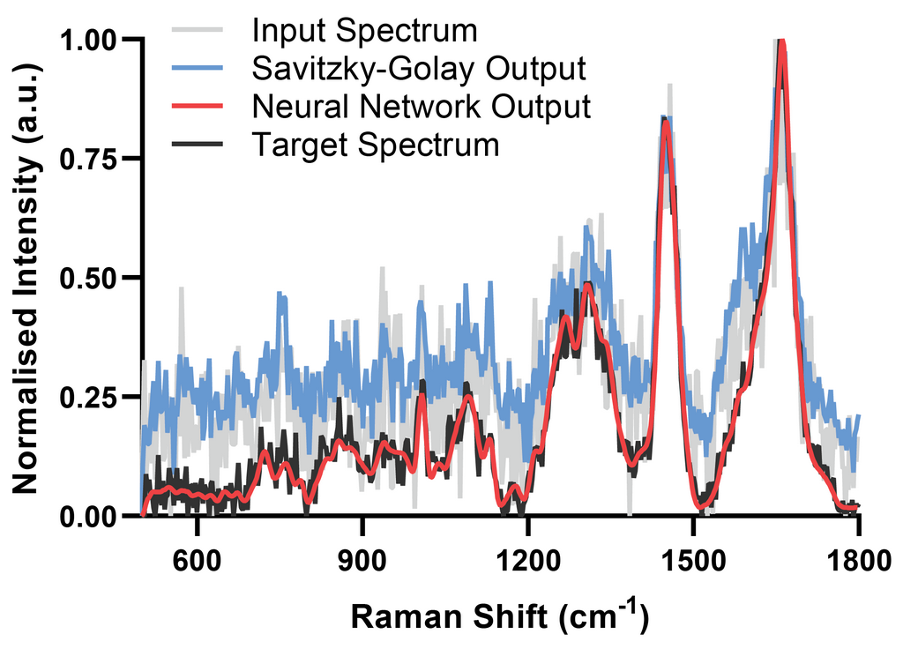
Using a ResUNet model trained on 172K paired low/high-SNR Raman spectra from MDA-MB-231 breast cancer cells, SpectrAI dramatically enhances signal quality, enabling shorter acquisition times without sacrificing data fidelity.
Hyperspectral
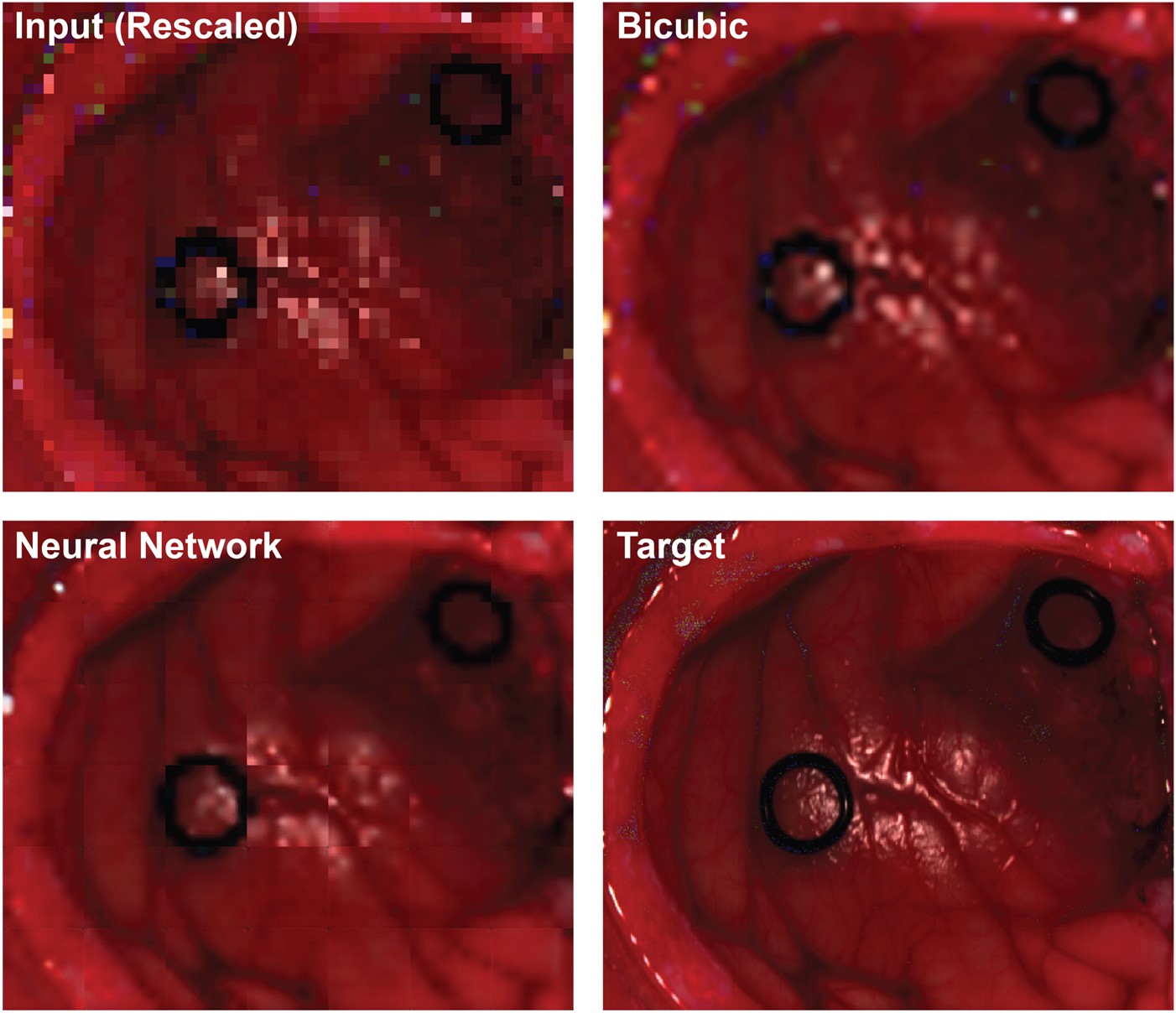
Applied to intraoperative hyperspectral brain images, a residual channel attention network (RCAN) model simultaneously preserves spatial resolution and spectral fidelity, opening new avenues for real-time intraoperative guidance.
Segmentation
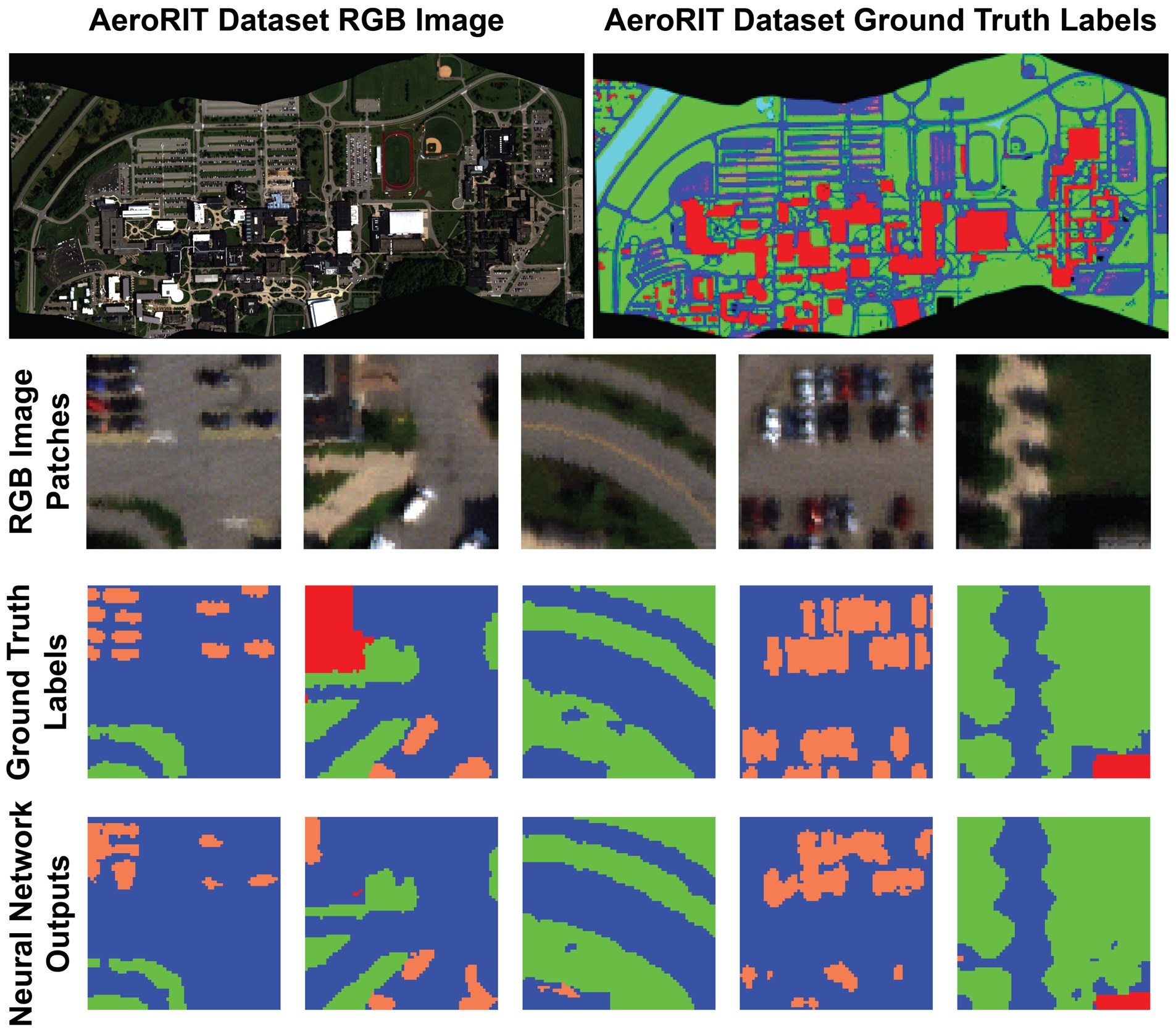
A UNet model trained on the AeroRIT hyperspectral aerial dataset demonstrates how SpectrAI handles large spatial-spectral datasets for scene understanding, relevant to remote sensing, cell biology, and clinical imaging alike.
Transfer Learning
Training deep neural networks from scratch demands large datasets and compute. SpectrAI's transfer learning workflows let you adapt a pre-trained model to new spectral domains in a fraction of the time — lowering the barrier to entry for all labs.
All benchmark datasets used to validate SpectrAI are openly shared. Use them to train your own models.
172,312 paired low-SNR (0.1 s) and high-SNR (1 s) Raman spectra from 11 MDA-MB-231 human breast cancer cells, acquired on a confocal Raman microscope.
Download Dataset169 hyperspectral Raman images of MDA-MB-231 cells, acquired using 532 nm excitation on a confocal Raman microscope. Ideal for spectral image enhancement studies.
Download DatasetHyperspectral aerial scene over Rochester Institute of Technology. Rangnekar et al., IEEE TGRS 58(11), 2020. Reference benchmark for spectral segmentation algorithms.
Access Dataset36 intraoperative hyperspectral brain images from 22 patients, averaging 439 × 400 px with 826 spectral bands (400–1000 nm). Fabelo et al., IEEE Access 7, 2019.
Access DatasetIf SpectrAI contributes to your research, please cite the following paper.
Analytical Chemistry, 93(48), 15850–15860
SpectrAI was developed by Dr Conor Horgan and Dr Mads Bergholt at the Label-free Bioimaging Laboratory, King's College London, back in 2021 to build an open community around AI-enabled spectroscopy.
Our goal is to lower the barrier to applying deep learning to spectral data, making reproducible AI-assisted spectroscopy accessible to every researcher regardless of their computational background.
See the Publications section for full citations and one-click BibTeX.